


Yun Goo: The Creator Behind the Viral HelixCore Spinner
His day job involves designing press molds that produce millions of parts, but what truly made him famous is a small toy printed one piece at a time.
 On the day this article was published, this model had accumulated 22.3k downloads, 19.2k prints, and over 1,200 ratings on MakerWorld. In Malaysia, where Yun lives, nobody recognizes him for this creation; but in China, people primarily know him by his MakerWorld nickname "YY the panjang" and will stop him at events to ask for autographs.
For the past 16 years, Yun Goo has been designing products that would be manufactured in millions: injection molds, mass production, identical parts stamped out one after another. In this type of work, success means that the thousandth piece looks exactly like the first.
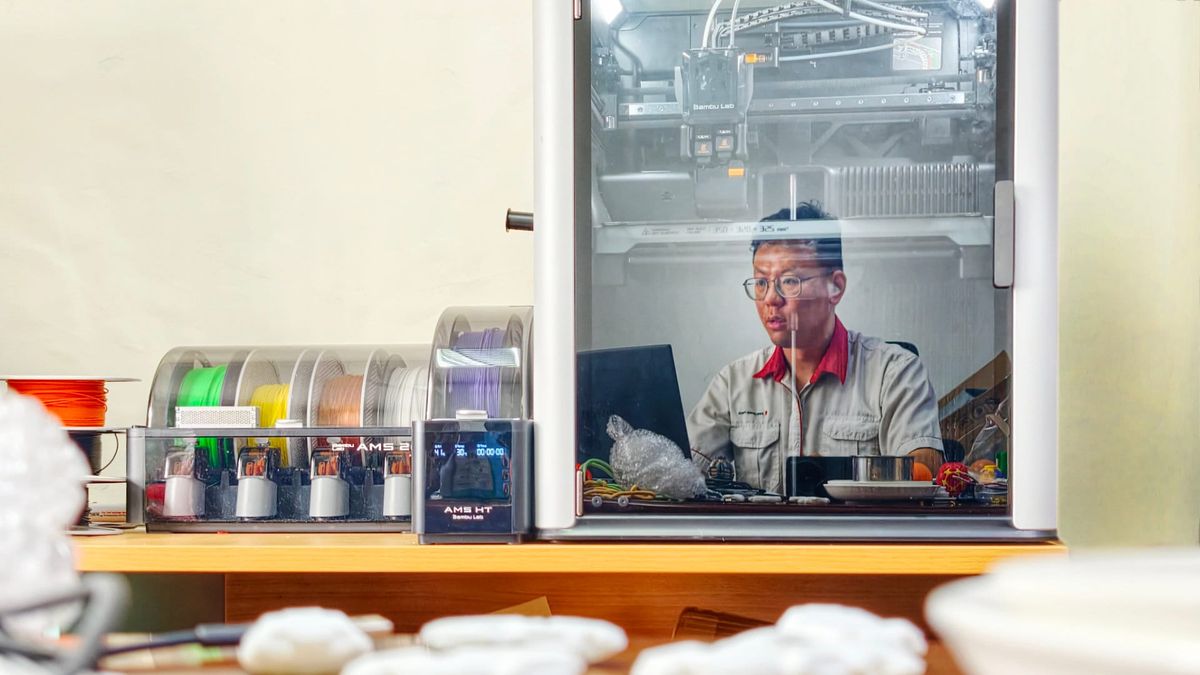
Meanwhile, he became known for something entirely opposite – toys made one at a time on a desktop 3D printer, printed one by one.
At first glance, it's an extremely simple object: a ball that spins when pressed, and that's it.
Yun calls it HelixCore.

When asked why his models consistently break popularity records, he gave a surprisingly frank answer.
"If you ask me how to make these things go viral, honestly, I have no idea. It just happened."
But don't let that statement mislead you. There's no coincidence involved... This is the result of years of manufacturing work and experience, naturally evolving into using 3D printers to create excellent work.
The Factory That Taught Him Everything
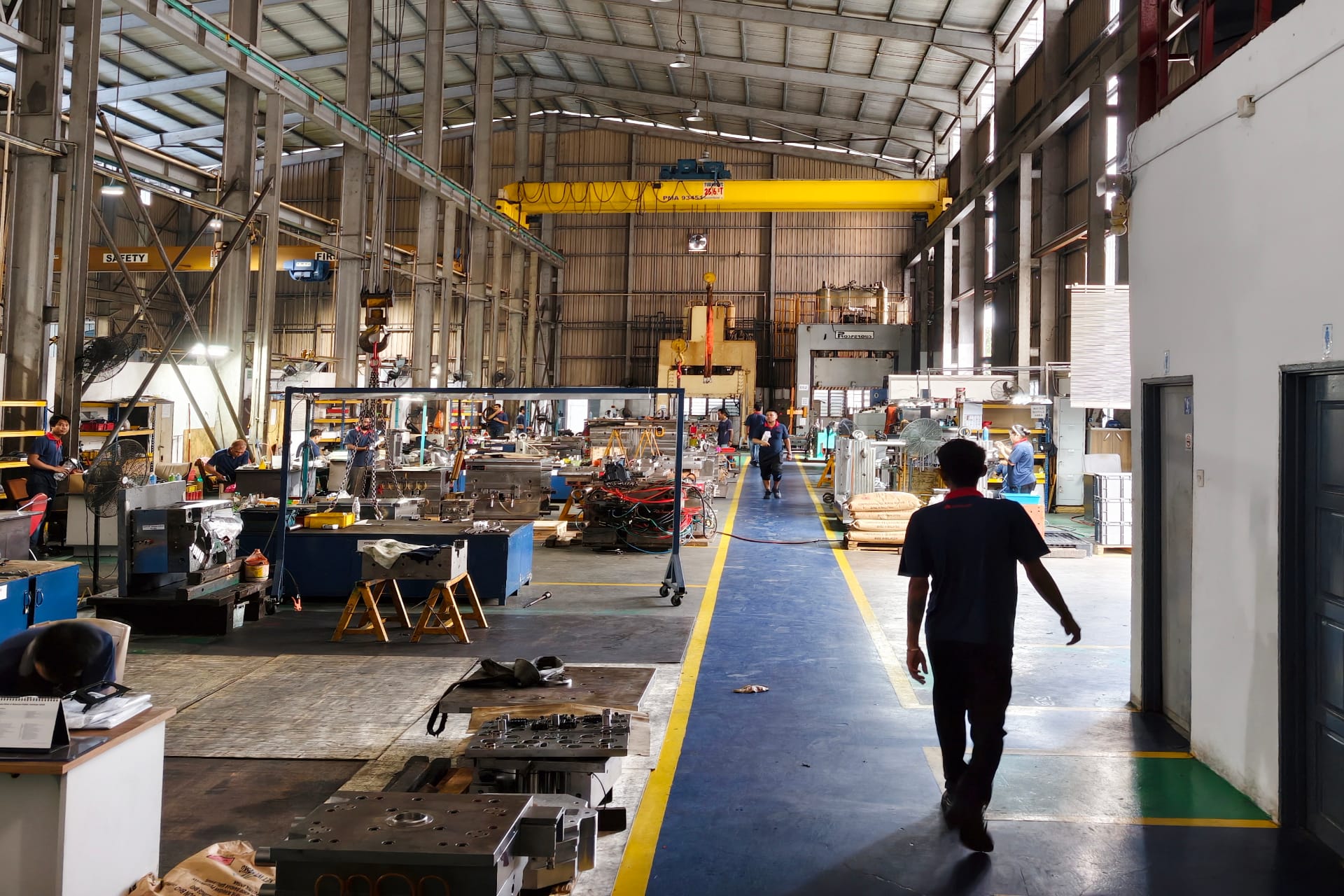
Before we talk about printing bananas, oranges, and spinning balls, we need to go back to the factory floor, because that's where the whole story begins.
Yun works in a family company founded by his uncle, who still serves as a director. He joined the company partly by chance and partly out of necessity. He studied aircraft maintenance but never actually entered the aviation industry.
"My educational background is a bit strange. I studied aircraft maintenance, but I never entered the aviation industry."
Yun's father passed away when he was young, which changed his life plans. He didn't want to spend years studying; he wanted to start earning money, so he joined his uncle's factory and learned the business inside and out. He didn't start at a designer's desk or in an existing position, but from the ground up, experiencing every step of the process.
"Basically, I learned everything in this company. Every process, from polishing, machining, to laser welding. Every skill required to make molds, I learned."
It's worth pausing here, because this isn't an ordinary resume. Making injection molds is one of the most demanding jobs in the entire manufacturing industry. Molds are negative forms of products machined from steel, with tolerances measured in hundredths of a millimeter, and must withstand tens of thousands of cycles of hot plastic injected under pressure.
You don't just design the part itself, but also how the plastic flows into the mold, how it cools, how it shrinks, and how the finished product is ejected without damage. Yun has done it all: from product design, mold making, and production, all the way to production line automation and PLC programming; the entire chain, from the first drawing to a self-running machine.
Therefore, his perspective on 3D printing is different from most people who start in this field.
Yun doesn't see a printer like a hobbyist who just discovered that layers can stick together and the first layer must stick to the print bed.
He sees it as someone who clearly understands how many steps, how much money, and how much responsibility lie between a beautiful drawing and a physical object that can be held. This perspective will reappear many times in the story, as it explains almost every decision he makes.
Ten Years, Three Self-Built Printers, and One Failure
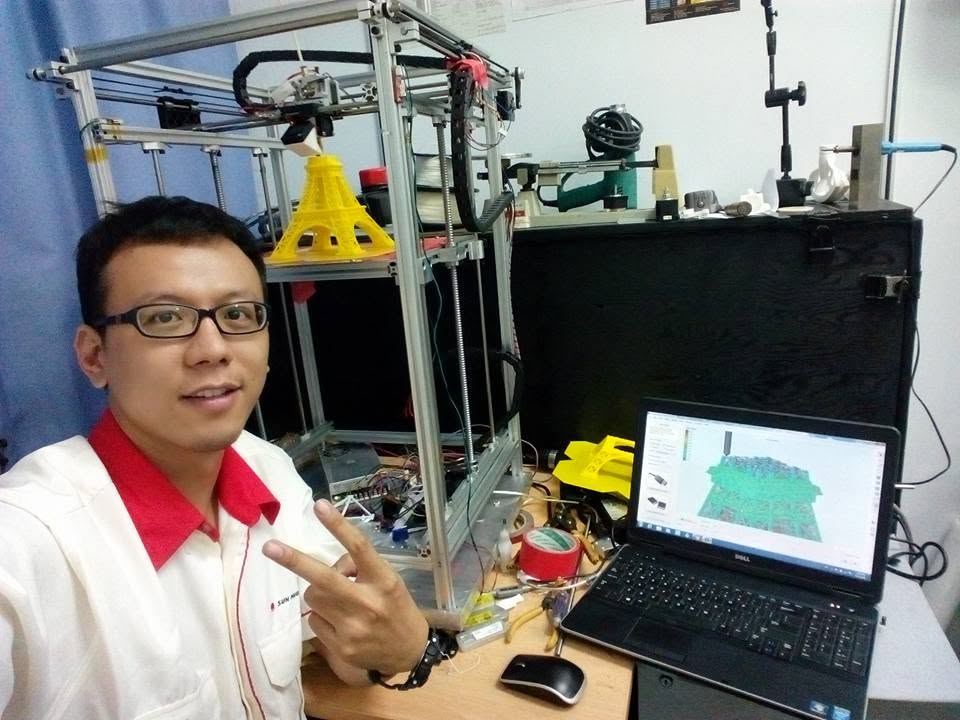
Yun's exposure to 3D printing goes back much further than his recent fame suggests—over 10 years. He started like many of his generation: by ordering a DIY kit from Taobao.
The machine body was made of laser-cut polycarbonate sheets, and the heated bed was covered with ordinary painter's tape. It was a machine that required patience, and also the acceptance that a significant portion of prints would look strange or fail completely.
This would deter most people, but Yun was captivated—so much so that he started building his own machines from scratch.
The second one was more serious: an all-metal body, an Ultimaker-like frame, and a linear motion system based on MakerBot profiles.
The third one was the most ambitious and wildest: around 2018, he built his own four-nozzle printer, at a time when multi-material printing was still only explored by a few enthusiasts.
Two nozzles worked properly; the other two never did.
The project stalled. Yun set it aside, and shortly after, he also set aside 3D printing entirely, for several years.
Life went on, and the machines remained there.
This is an important moment in the story because it shows that his later success didn't come from an easy start, but from a long period of trial and error: nothing groundbreaking happened, and several things just failed.
It wasn't until last year that he returned. He returned because he kept hearing a name on everyone's lips.
"When I returned to 3D printing, I kept hearing this name: Bambu Lab. Everyone said it was a very good printer, a great machine. So I was curious and bought a P1S."
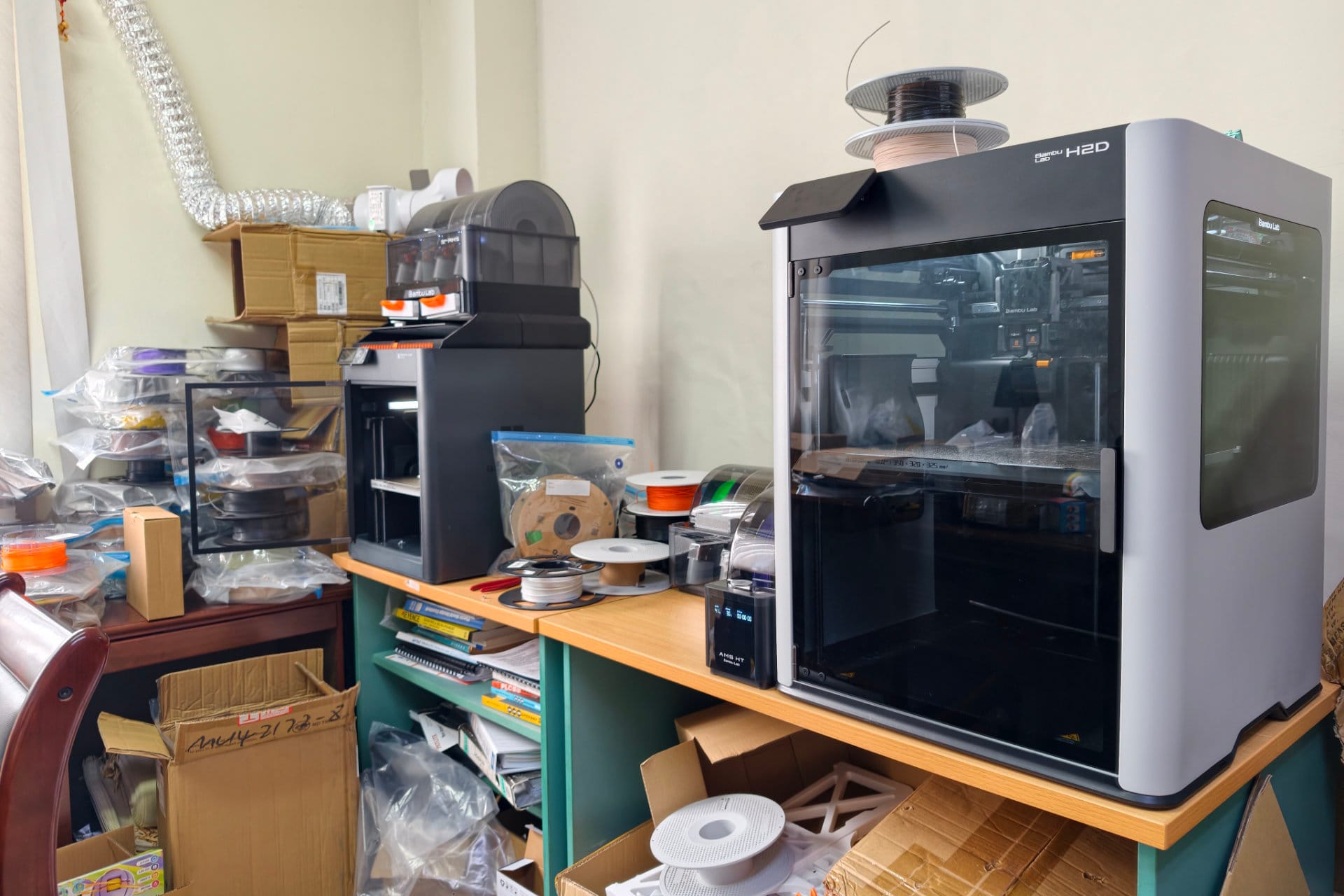
Compared to his self-built four-nozzle machine, the difference was fundamental: this was a machine that just printed, without needing you to fix it first. Yun started printing again, buying consumables, making this and that. Then, almost naturally, he transitioned from printing other people's files to creating his own designs.
A Few Hours After the Kids Are Asleep
He started designing rather than just printing for a mundane, yet serious reason: money.
"At first, it was just for fun. Then last year, I encountered some financial difficulties and was trying to find a side income."
The situation didn't leave him much room: a full-time job at the factory, two children, and a home that only quieted down late at night. Free time only appeared in a narrow window after the children were asleep, just a few hours, no more. Whatever side hustle he pursued had to fit into this time without disrupting everything else.
He tried different things before he found something that worked.
"I tested many things. I tried e-commerce, even sold insurance. But none of them worked for me. Then I realized that this 3D printing design thing was a good fit for me."
Design had an advantage that other ideas lacked: it accommodated his rhythm, not the other way around. It didn't require him to be constantly on call at specific times, didn't chase him with client deadlines, and didn't demand immediate service to anyone.
Moreover, it could generate some income. At first, this was enough to make him take it seriously.
Why the Banana Must Open
Yun knows something that most makers don't, but which is a game-changer for mass production: when it comes to volume, 3D printing cannot compete with injection molding.
At scales of tens of thousands, hundreds of thousands, or a million pieces, injection molding wins on cost every time, by a huge margin.
Printing the same item on a 3D printer is slower and more expensive per piece, and this won't change. For someone with his experience, this isn't an opinion, but arithmetic. From this arithmetic, he drew a conclusion that became his method.
"3D printing cannot compete with injection molding. There's no way to compete in terms of volume. Therefore, when we create something for 3D printing, it must be unique. We can't do it the usual way."
For Yun, "unique" has a very specific engineering meaning: movement. Mechanisms hidden within the object. Something that comes alive in your hands.
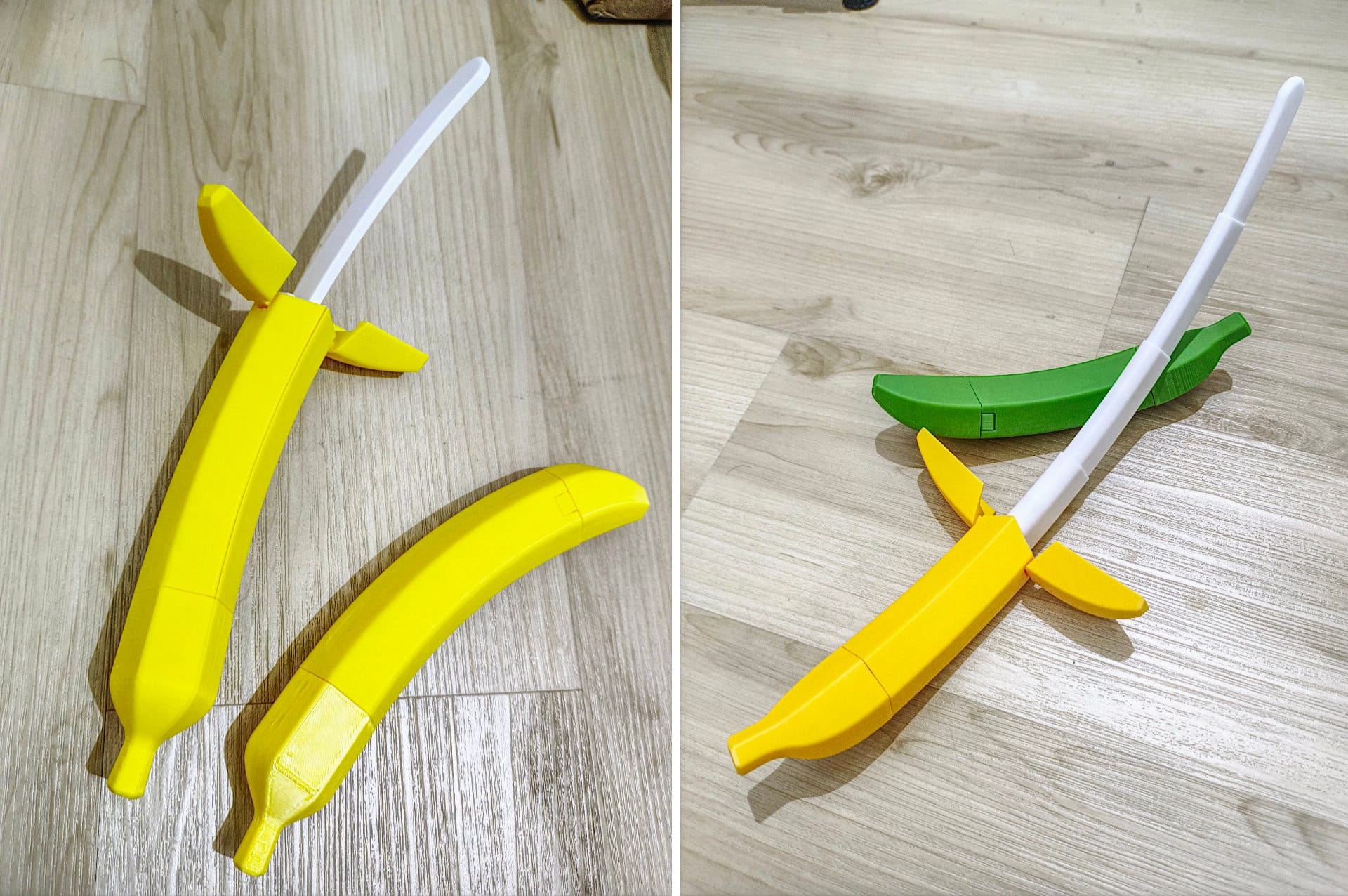
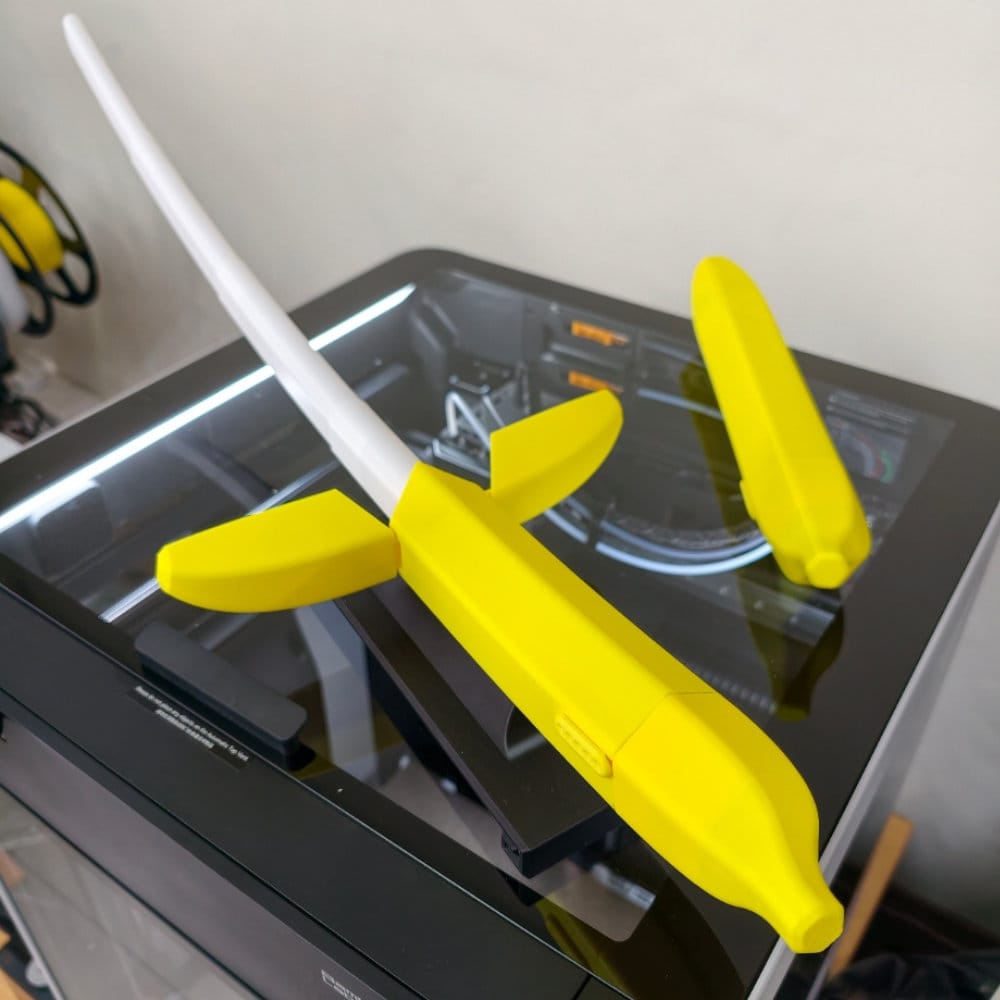
This was already evident in his first model. The Banana Katana came about because his son wanted a toy, and Yun happened to have a newly acquired printer and a reason to use it.
"I wasn't the first person to make this banana katana. But I printed one and thought, hey, I can add a little mechanism inside to make it different. So I added a mechanism, and when you twist it, the banana opens. The mechanical aspects are my strong suit."
Here, 16 years of mold-making experience became a real advantage. Designing movable parts requires the same knowledge used when building molds: how components fit together, how much clearance to leave for rotation without wobbling, how to choose tolerances so it works correctly the first time.
On the factory floor, this knowledge is used to make injection molding machines produce identical, flawless parts; at Yun's desk, he uses it for something entirely different—to give a single printed piece a spark that mass-produced toys simply don't have.
An Orange, Some Lights, and a Spinning Ball
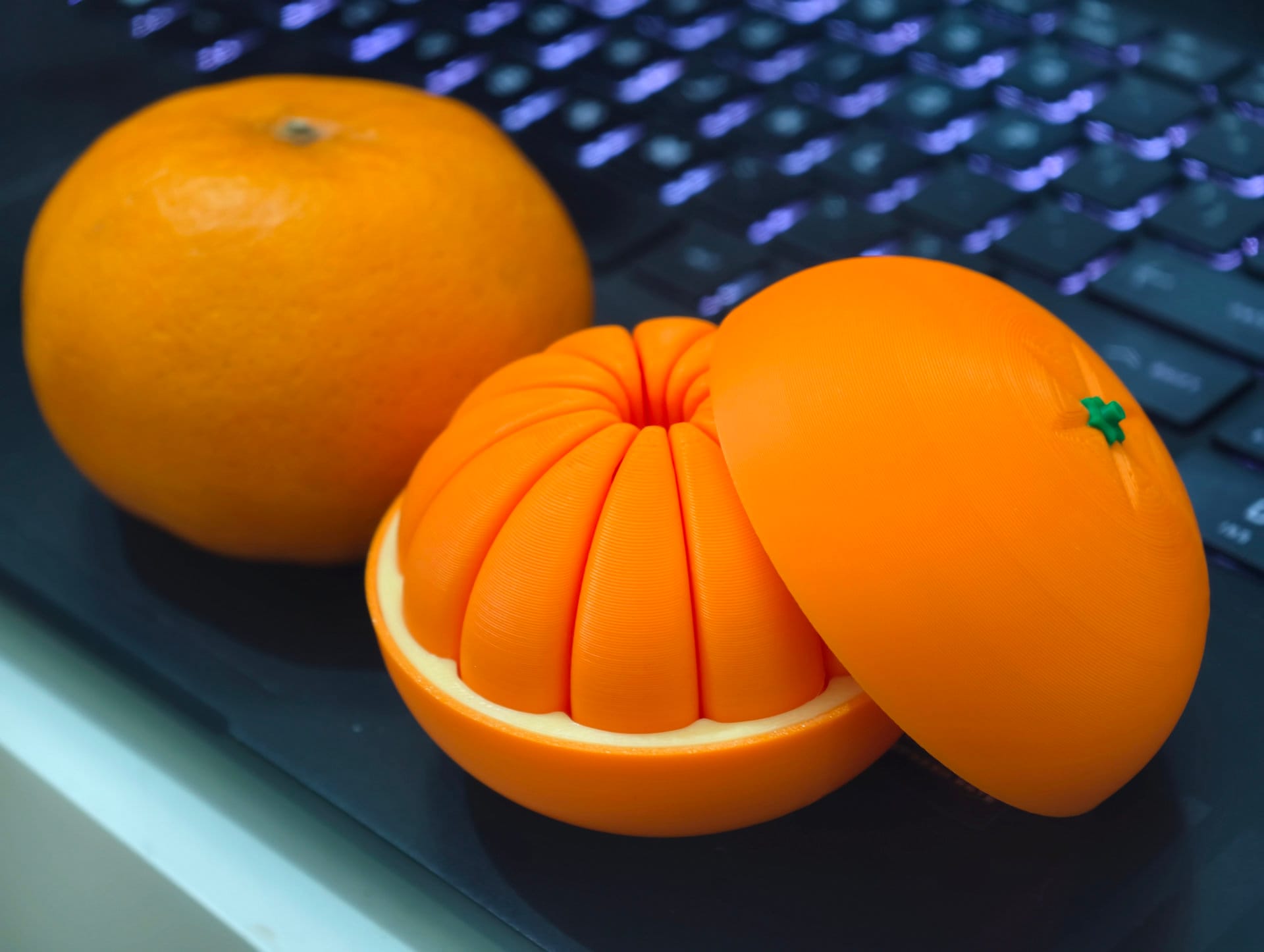
After the banana came the orange. More precisely, a citrus-themed fidget toy designed before Chinese New Year, with very personal origins.
"During Chinese New Year, we eat these mandarins in Malaysia. So I thought, why not make a fidget toy that looks like a mandarin? And honestly, when I peel an orange, I always want to peel it in a certain way."
This little object contains a touch of Yun's own personality. He transformed an everyday action—peeling an orange in a specific, satisfying way—into a design.
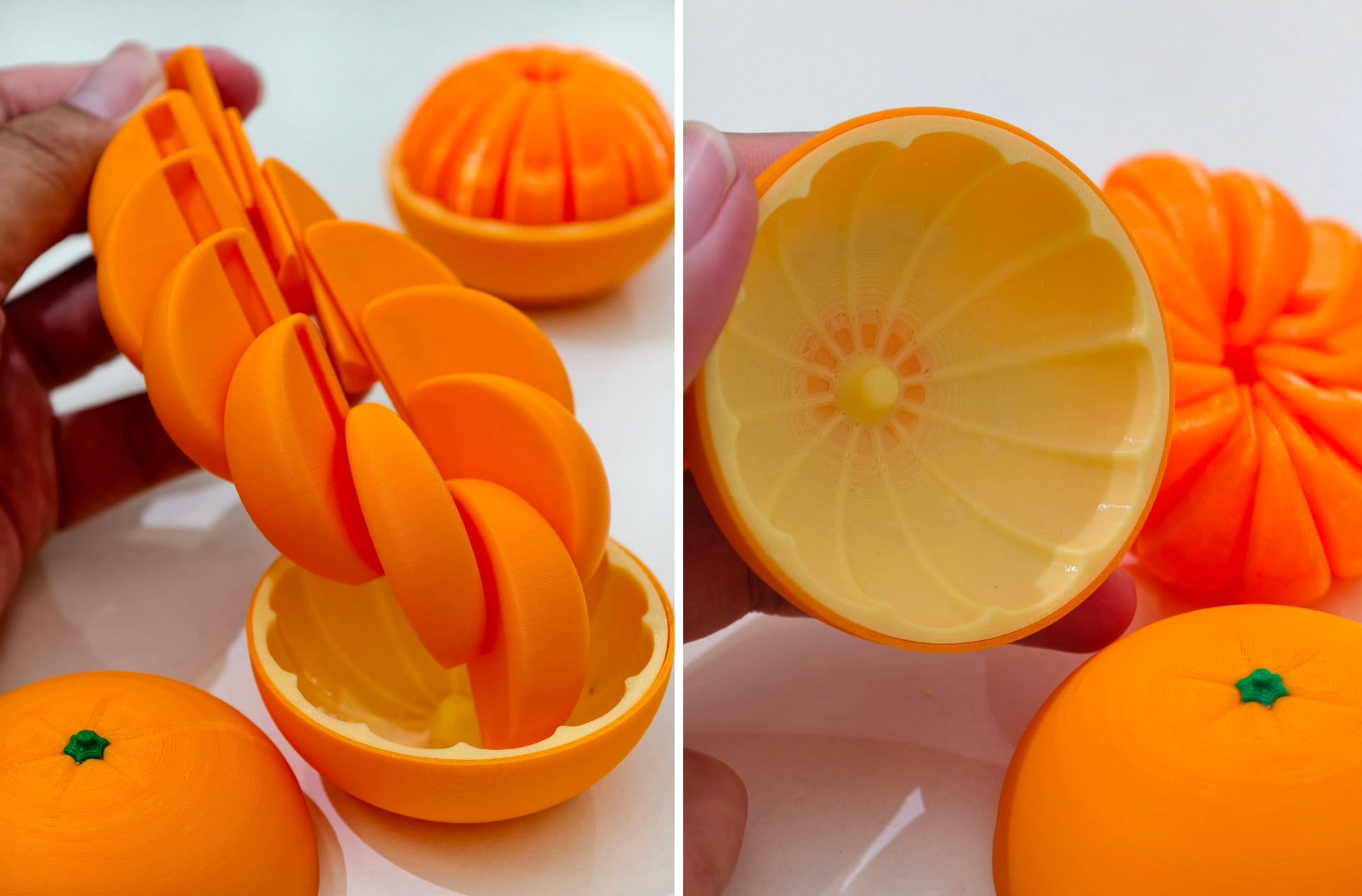
This model garnered over 12,000 downloads, roughly the same as the banana model. At that moment, he felt he had found his direction: fidget toys and fruits, movable, simple, relatable, and effective.
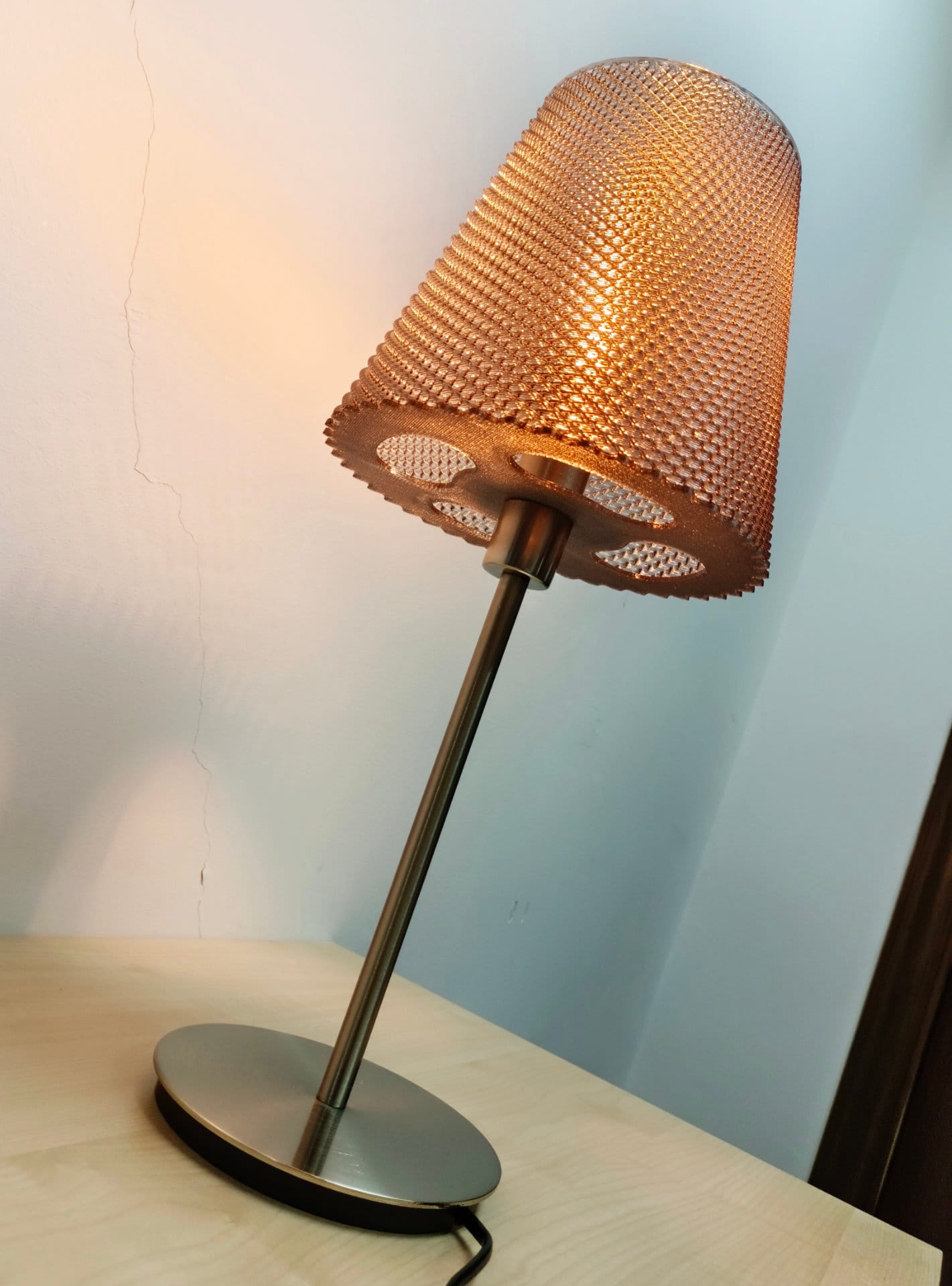
There were failures along the way, such as the lamps. Yun noticed that selling printed lamps could be very profitable, with a large gap between production cost and selling price, so he tried it, but it didn't succeed.
Then HelixCore emerged, and the scale changed dramatically.
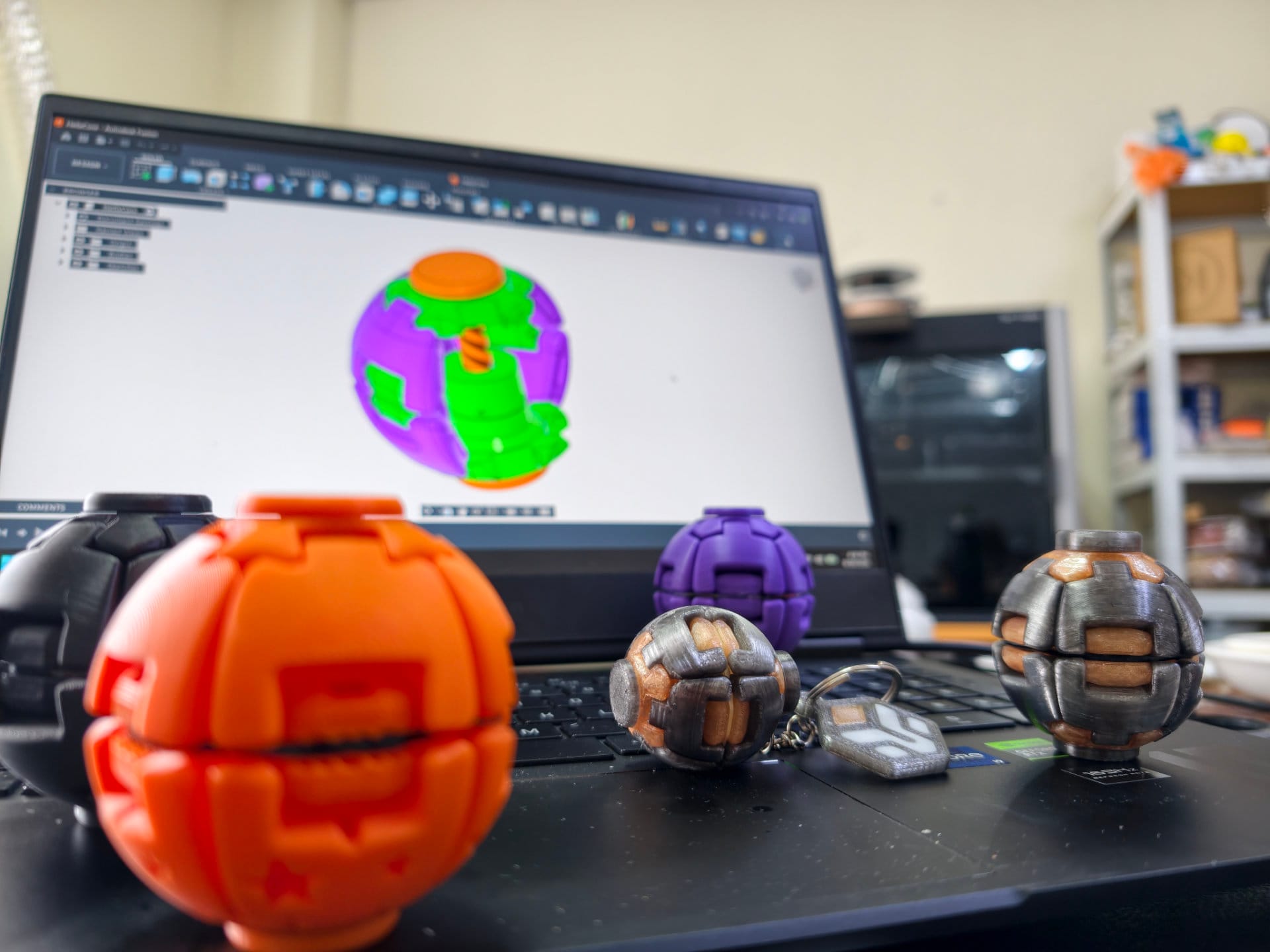
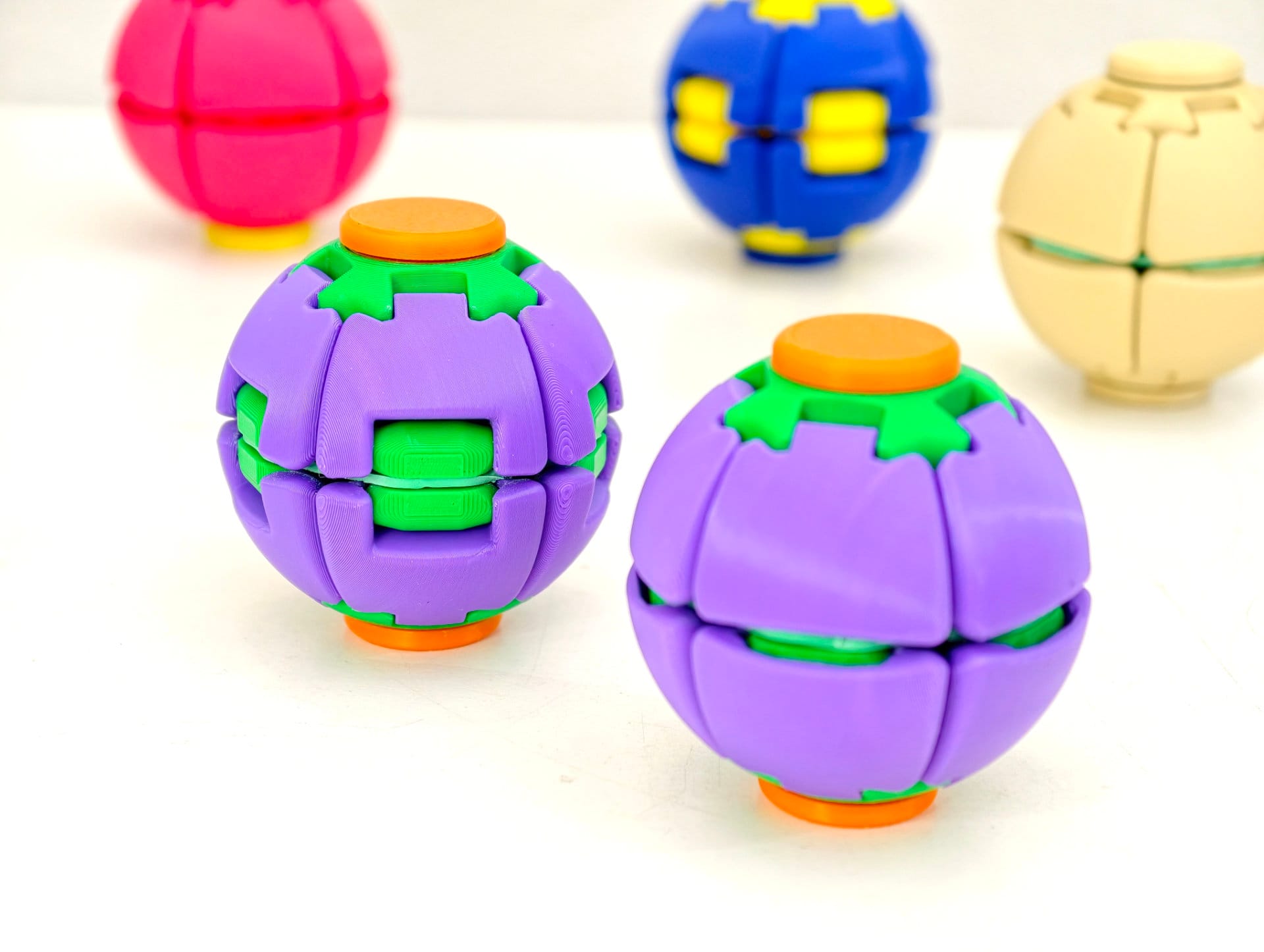
As is Yun's usual practice, it started from an existing design. He printed several popular stress balls, the kind that make a satisfying click when squeezed. He liked them, but as always, felt they were incomplete: they lacked something he knew how to add better than anyone.
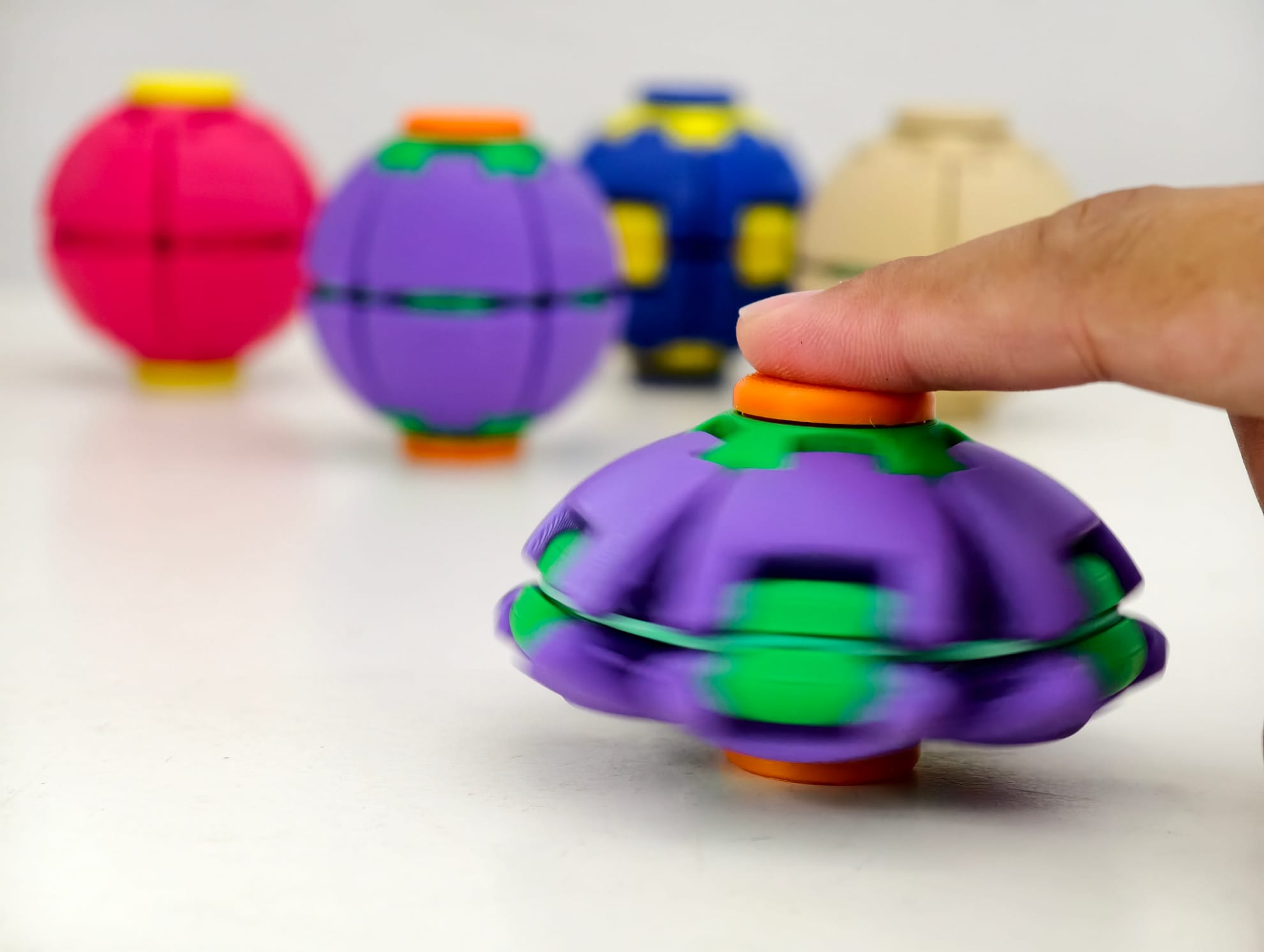
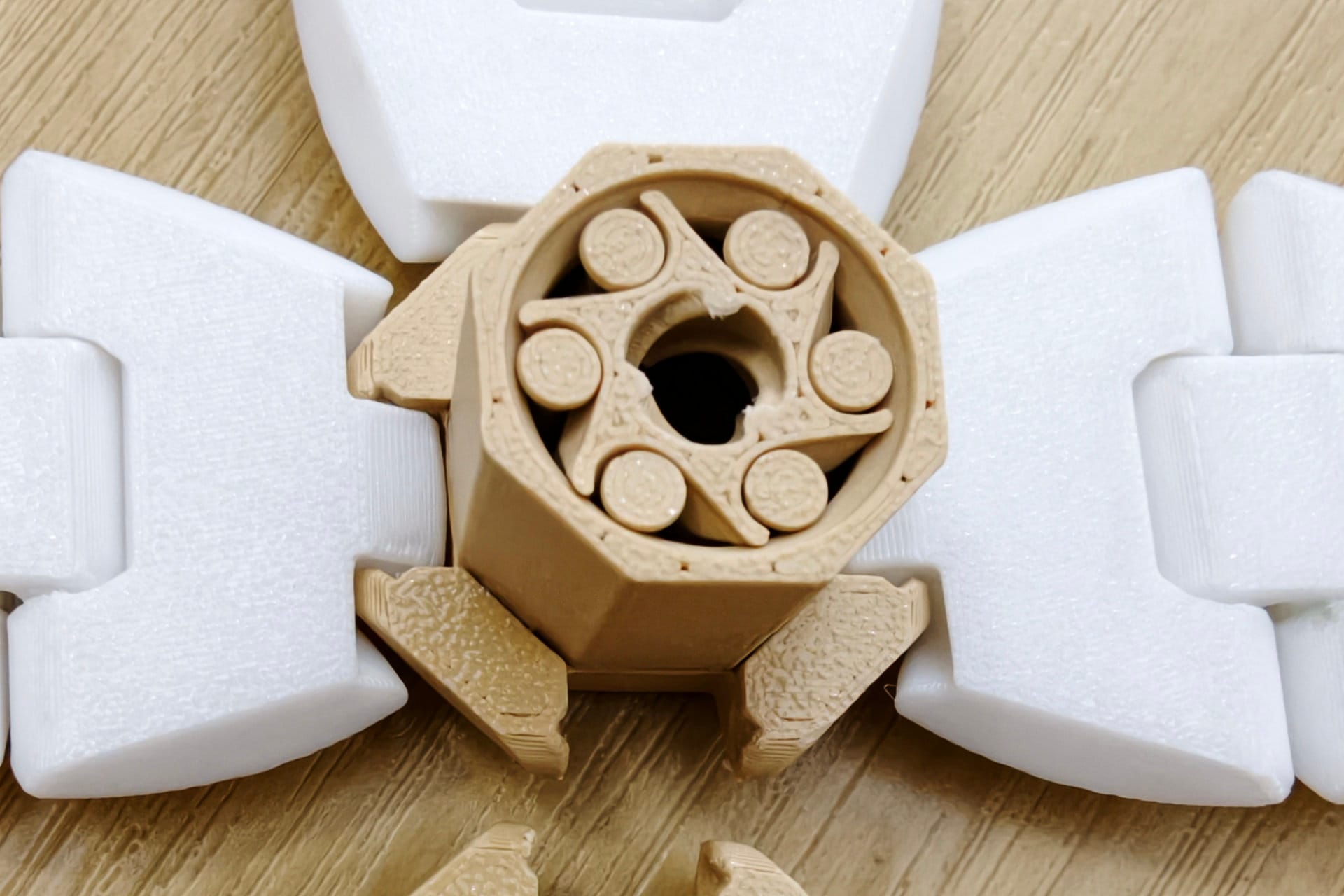
He sat down and designed a ball with an internal bearing and screw mechanism. Press it, and it spins. A simple idea, precisely executed, exactly what he learned to do from his mold work.
During the creation of the model, something happened that even he couldn't quite explain, but which many creators will recognize.
"When I was making that design, I had a feeling. It's hard to describe, but it was like something was pushing me from behind, telling me this might be the direction. Like something magical was about to happen."
His intuition was correct. Helix went further than any of his previous works: 22.3k downloads, 19.2k prints, and over 1,200 ratings on MakerWorld.
On Chinese TikTok, a video of the spinning ball accumulated approximately 400,000 views—and in the 3D printing community, this means that the vast majority of people involved in the hobby in China have likely seen it.
Unknown in Malaysia, Yet Recognized in China
Then, the part he never expected began: being recognized. But not in the place of his daily life.
"In Malaysia, I'm still a nobody, just an ordinary person. But when I go to China, people recognize me. They ask for autographs, for photos together."
It's fair to clarify: this refers to the 3D printing community, not street fame. His videos have been watched by hundreds of thousands of people involved in the technology, so when he appears at industry exhibitions in China, people recognize him.
Outside of the industry, he remains anonymous in China, and even more so in Malaysia; he picks up his children and buys groceries like everyone else. But for someone who, just a year ago, was only designing for himself at night, the mere fact that someone asks for his autograph must feel like a dream.
For him, publishing on MakerWorld wasn't a matter of chance or vanity. Yun explains it like an engineer who understands that "a design without an audience doesn't really exist."
"No matter how good a design is, if no one sees it, it's still a failure. To go further, you have to put your work where people can find it. Otherwise, it just sits on your hard drive, going nowhere."
Currently, he uses three Bambu Lab printers, and his choice of them once again reveals his engineering mindset. He started with a P1S, then bought an A1 for a very specific reason: comments started appearing under his models saying that print profiles weren't working properly on the A1. Instead of ignoring or guessing, he specifically purchased the machine to test it himself.
"Before I upload any print profiles, I make sure they print well and stably on my own printer. Only then do I upload them to MakerWorld."
This is the same discipline that determines whether a mold in a factory is ready for production. It's not enough for it to work successfully once in your hands; it must work consistently, and it must work in the hands of people who have never seen it and don't know its weaknesses.
His third printer, the H2D, was acquired using points earned on MakerWorld itself, bringing the process full circle: the platform he publishes his work on actually paid for the machine he uses to create his next batch of models.
He designs using Fusion 360, which is also a professional decision based on cost. Yun is familiar with more powerful and expensive engineering software from his day job, but his reason for choosing Fusion is simple: his license costs about 2,500 MYR, while professional software could cost hundreds of thousands, and for what he needs to do, both offer very similar capabilities.
For someone who started due to financial problems, this is not an insignificant difference.
It's worth zooming out a bit because Yun has also witnessed how 3D printing has changed in his region. Malaysia is only just beginning to adapt to this technology.
"When I started with 3D printing ten years ago, I couldn't find anyone who shared the same interest."
Today, Malaysian Facebook 3D printing groups have 20,000 to 30,000 members. While relatively few people still own printers at home, and the overall user base is still small, it's a huge leap compared to the days when Yun was assembling printers from polycarbonate sheets. He himself is part of this change and one of its more prominent faces.
The Millions He Didn't Lose, and a Door He Wants to Open
There's a part of this story that could easily be framed as an injustice. Yun's take on it is completely different, and his attitude towards it is perhaps the most interesting aspect of the entire interview.
Helix began to be commercialized. Someone took his design and started making physical toys to sell. At the time, Yun did not have a patent for it.
"I keep hearing people in China say that I lost millions."
This statement doesn't align with his thoughts, and the reason why is worth precise explanation, as it's easy to misinterpret. Yun isn't simply shrugging off plagiarism, nor is he saying that unauthorized mass production is okay. His perspective is narrower, and it's a perspective only someone who understands scale would have.
"Even if millions were sold, there's no way I could have made and sold all those millions myself."
Beyond a design, there's manufacturing, quality control, packaging, distribution, logistics, and the thing creators think about least—liability.
Including the heaviest kind of liability: the kind you only start thinking about when something goes wrong, like a child swallowing a piece from a poorly designed toy. To make a product happen at that scale requires factories, e-commerce, distribution, and many other people.
So, he doesn't see every replica sold as money taken from his pocket. However, he still believes that original designers deserve respect and proper compensation.
Crucially, the story doesn't stop at this realization. Since the HelixCore incident, Yun has begun applying for patent protection and building a more formal licensing system around his designs. He also found someone willing to support him—an investor who believes in the project and supports the IP aspect. Together, they have invested approximately 100,000 RMB in patents and IP protection.
"Honestly, when I first uploaded a small spinning ball to MakerWorld, I never thought I'd be doing these things, haha."
Even more interesting is how he now views the patent. For most people, a patent is a wall, a way to stop others; Yun, however, is drawn to the opposite idea.
"I don't just want to use the patent to prevent others from copying; I also want to see if I can use it to open a door for other designers."
The vision is still taking shape, but the outlines are clear. If successful, other designers could develop their own ideas around the HelixCore mechanism with proper permission, and Yun could help connect excellent work with manufacturers and licensing partners. This stems directly from what he learned the hard way.
There are many talented designers who can create amazing things on 3D printers, but going from a printed model to a truly mass-produced product is a completely different world—it's the gap he personally crossed with Helix.
"So, maybe one day, I can make it a little easier for other independent designers to walk this path."
For someone who, just a year ago, was only designing for himself at night, this is a remarkable outcome. MakerWorld brought him an income that fits the rhythm of his life with two children and a full-time job—the side income he was always looking for but couldn't find in e-commerce or insurance.
It gave him an audience on the other side of the world; people who print his designs in places he's never visited. It gave him the identity of a creator, something he never even considered a year ago. In his balance sheet, this is not a list of losses.
"It has changed my life."
Creation is never easy. When Yun's designs started circulating online through unauthorized resales, the MakerWorld team contacted him almost immediately. The platform considers copyright protection one of its core responsibilities to creators.
Dora Ding, Creator Relations & Operations Expert at MakerWorld, stated: "The moment we discovered the infringement of this exclusive model, we contacted him directly and offered our full support."
In practice, this means assisting Yun in filing takedown requests for infringing listings and stating that they will continue to take action against unauthorized websites to ensure that creators' hard work receives the respect it deserves.
In his daily life, Yun still goes to his uncle's factory, still wears his company uniform. He talks about this with emotion, because it's the flexibility of the family business that allows him to board a plane to another exhibition in China when invited.
He's already designing more fruits: bananas, oranges, and perhaps one day, a pineapple. He's also preparing a smaller version of Helix, this time without bearings, because users started requesting it in the comments—and he listens.
When he tries to summarize what has happened to him over the past year in one sentence, it still sounds like he can't quite believe it himself.
"It's been a very strange experience. I would say, very strange. I never expected something like this to happen in my life."
Yun Goo, known as YY the panjang on MakerWorld, started with a banana he made for his son; the printer was bought partly out of curiosity, partly out of necessity.
Ultimately, he became the person stopped for autographs at trade shows in China; one of his spinning ball models reached hundreds of thousands of people.
Between the two is 16 years of injection molding experience and a simple principle he took away from it:
If you want people to print your work instead of buying a finished product from a store, make it do something a finished product cannot.
Article source: Bambu Lab Blog
 From August 21-31, purchase a P2S Combo and receive 2 rolls of Bambu Lab PLA Basic filament for free!
Contact us for more information about Bambu Lab 3D printers!