


We always talk about transformation, and how we must transform, but we face various challenges:
1. Customers demand small batches with high variety, and highly customized component products.
2. Response time to customer needs is too short.
3. Difficulties in machining component geometries, which traditional machining cannot achieve.
4. Variable or complex geometries, leading to excessively high mold costs (time cost/manufacturing cost).
5. Demand for lightweighting without compromising product strength/functionality.

Processing time is infinitely occupied, in an endless cycle...
HP Jet Fusion 3D Printing Solution precisely reshapes the design and manufacturing process. From accelerating design cycles to printing functional parts, to achieving efficient mass production with repeatable part quality.

Multi Jet Fusion (MJF) is an additive manufacturing technology designed by HP. MJF belongs to the powder bed fusion family of technologies, which also includes Selective Laser Sintering (SLS) and binder jetting. It can produce detailed functional prototypes and low-to-medium volume production parts. Multi Jet Fusion printers create plastic parts that are relatively strong, highly detailed, and have near-isotropic mechanical properties.

How do MJF 3D printers work?
The 3D printing technology used by HP is Multi-Jet Fusion, with the following forming steps:
1. Material is loaded into the 3D printer, and the print carriage starts and slides across the powder bed according to programmed digital instructions to begin production.
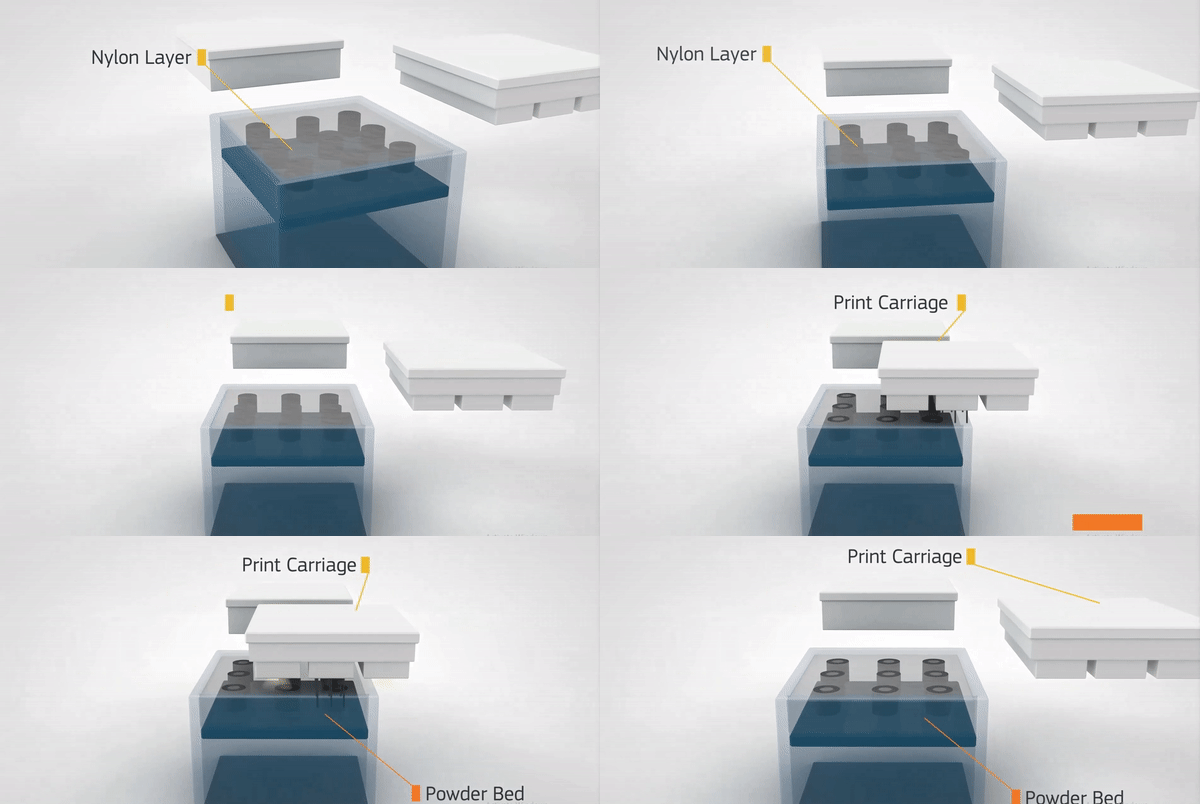
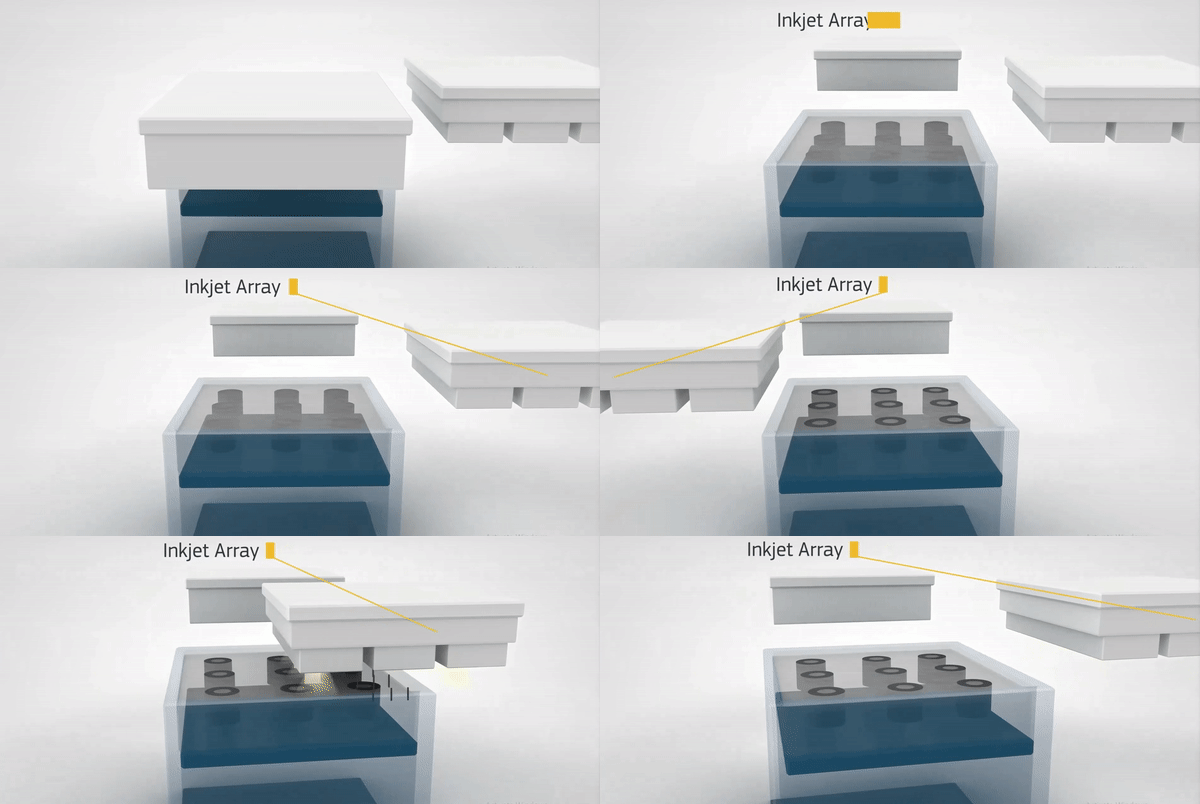
2. The inkjet array selectively applies fusing and detailing agents onto the powder bed, then fuses them together into a solid layer of the part's geometry using thermal energy.
3. Powder is distributed by the material recoating unit, and this process is repeated layer by layer until the build is complete.
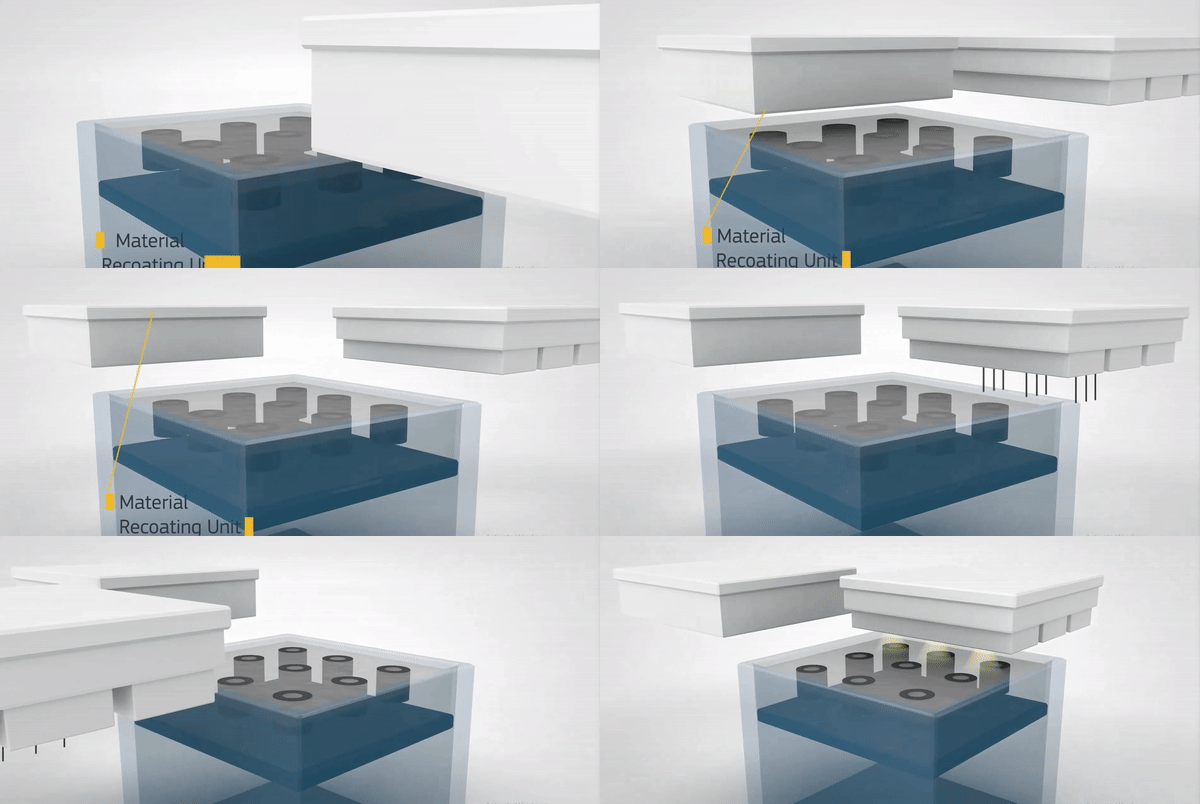
HP's Multi Jet Fusion Technology Principles
➊Lay down the forming powder

HP's proprietary architecture can print 30 million drops per second across every inch of the bed, achieving high precision and dimensional accuracy.
➋Jetting the fusing agent

An agent is applied to the material layer to fuse the particles together.
➌Jetting the detailing agent

Then a detailing agent is applied to modify the fusion and create detailed and smooth surfaces.
➍Apply energy to the build area to fuse the powder

The area is exposed to energy, and the reaction between the agents and the material causes the material to selectively fuse together to form the part.
Repeat➊——➍the process until all slices are processed. Note that the areas where the detailing agent is jetted are not fused.
Advantages of Multi Jet Fusion 3D Printing
Fast Printing Speed
MJF is a fast additive manufacturing technology, which is the biggest highlight of HP 3D printers, surpassing ordinary technologies by 10 times. As shown in the figure below, for the same 38 hours, the extrusion technology (=FDM Fused Deposition Modeling) on the left prints 460 pieces; the Selective Laser Sintering (SLS) technology in the middle performs slightly better, printing 1000 pieces; but the Multi Jet Fusion (MJF) technology on the far right prints an astounding 12,600 pieces, far exceeding the first two!! This demonstrates that HP's 3D printers can meet customer demands in a short time.

FDM & SLS & MJF Print Speed Comparison
Strong Toughness and Durability
The video below briefly demonstrates the impressive quality of HP 3D printing. The team took only 30 minutes to print an oval part, and this part, weighing only about 113 grams, can withstand a 5-ton car!!!
Design Freedom
Since MJF belongs to the powder bed fusion family of technologies, it does not require support structures, as the powder itself provides support during printing. This allows for greater design freedom and results in no visible removal marks. Therefore, Multi Jet Fusion is very suitable for complex geometries. (Please note that large flat areas should be avoided as MJF does not handle them well. If large flat areas cannot be avoided, consider adding a lattice structure.)


High-Precision Printing
MJF can 3D print small features while retaining detail, with a minimum feature size of 0.02 inches or 0.5 millimeters. MJF can print 80 microns per layer.

Applications of HP MJF 3D Printers
Machinery and Transportation

• Battery cooling systems
• New car prototyping
• Interior components (1 million BMW window guides)
• New energy electric vehicles
• Drones
Healthcare

• Invisible braces, Smile Direct
• Prosthetics, assistive devices
• Orthopedic insoles, shoe soles
• Infant helmet for head shape correction
Industrial and Services

• Clamps, jigs
• Robotic arms
• Rapid tooling
• Hardware tools
• CNC complement
• Exoskeletons
Consumer Products and Electronics

• Customized eyewear
• Designer home furnishings, lamps
• Fashion shoes, orthopedic shoes
• Sporting goods
- Contact Us -
to inquire about more filaments and 3D printers! We'll help you make an informed choice based on your needs!
3DMart offers more than just 3D printing; we provide three major OEM services: "3D Printing Services", "3D Scanning Services", and "Spatial 3D Scanning Services"!!
Follow our fan page to stay updated:
Facebook : https://www.facebook.com/3dmart.com.hk/
Instagram : https://www.instagram.com/3dmart
LinkedIn : https://www.linkedin.com/company/3dmart/
References